
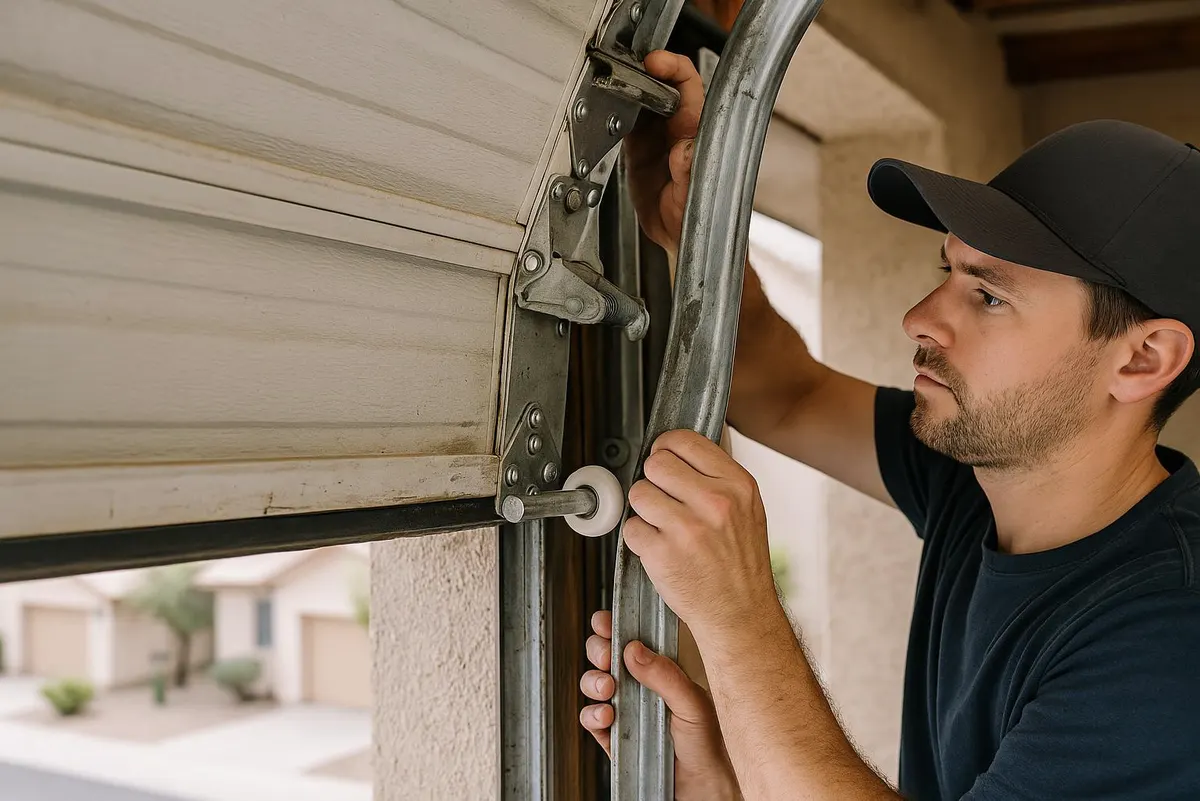
What a technician usually finds on these calls
Most emergency calls we get this time of year start the same way: a door that worked fine all through the dry months suddenly grinds, sticks, or won't budge the first time it rains. On the inspection, we usually find the same three things — tracks packed with months of dry-season dust and wildfire ash, hardware showing the first signs of salt-air corrosion on hinges and rollers, and a spring that was already two-thirds worn out and just needed one humid morning to finish the job. None of that happens overnight. It builds up quietly during the dry season and shows up the moment the weather changes, which is exactly why a quick seasonal check before the winter rain starts is worth the twenty minutes.
Tools you'll need
- Step stool or sturdy ladder
- Flashlight
- Clean rag and a stiff brush (an old toothbrush works)
- Garage door lubricant (silicone or lithium-based spray, not WD-40 or household oil)
- Tape measure or a 2x4 scrap of wood
- Work gloves
The 20-minute routine
- Look at the tracks. Run your flashlight along both tracks. Dust, dried leaves, and ash from dry summer winds settle here and can throw the door off alignment. Wipe them down with a damp rag, then a dry one. Don't lubricate the tracks themselves.
- Check the rollers and hinges. Spin each roller by hand. It should turn smoothly without wobbling or grinding. Coastal salt air speeds up corrosion on metal hardware, so look for rust spots or stiffness, especially on doors facing the ocean side of the house.
- Lubricate the moving metal parts. Spray hinges, rollers (not the wheel itself if it's nylon), and the top of the springs lightly. A thirty-second pass with the rag afterward keeps it from attracting more dust.
- Test the auto-reverse safety feature. Place a 2x4 flat on the ground where the door closes. Close the door — it should reverse the moment it touches the wood. Then test the photo-eye sensors by waving a hand in the beam while the door is closing; it should stop and reverse.
- Check the weatherstripping along the bottom and sides. After a dry summer, rubber seals often crack or shrink. Press on them — if they're brittle or there's daylight showing through, water will find its way in during winter storms.
- Tighten visible hardware. Using a socket wrench, snug up any loose bolts on the track brackets and hinges. Vibration from regular use loosens these gradually.
- Test the balance. Disconnect the opener by pulling the release cord, then lift the door halfway by hand. It should stay put on its own. If it drifts up or crashes down, the spring tension is off.
Where to stop and call a technician
Steps 1 through 6 are safe, straightforward homeowner maintenance. Step 7 is where you stop touching things and start making a call. If the door doesn't hold its position when lifted halfway, that's a spring balance problem — and torsion springs are under enough tension to cause serious injury if handled without the right tools. The same goes for any rust you can't wipe away, a track that's visibly bent, or an opener that strains and makes a new grinding noise. Those are jobs for a technician, not a Saturday afternoon project.
When to call Encinitas Garage Door
If your balance test fails, your springs look worn, or weatherstripping needs replacing before the rain starts, that's exactly what our Garage Door Maintenance visits cover — we inspect, adjust, and replace worn parts before they fail on you. And if a spring does let go, our Spring Replacement service gets it swapped safely the same day in most cases, no half-finished repairs left hanging over a holiday weekend.
If your seasonal check turned up something that needs a second set of hands, give Encinitas Garage Door a call — we serve Encinitas and the surrounding North County San Diego area and can usually get a technician out fast.